Cart 0


As October marks two years since the devastating war began in Gaza, the humanitarian situation remains one of the most dire in the world. Entire neighbourhoods lie in ruins, hospitals are overwhelmed, and basic necessities that many take for granted — food, water, medicine, and safety — are painfully scarce. Even the word “overcrowding” fails to describe the sheer number of displaced people filling every corner, street, sidewalk, or unfinished house, or huddling in torn tents that could not withstand the heat of summer let alone the cold of winter.
“Behind the walls of harsh reality, life in the Gaza Strip seems faceless,” says Doaa Al-Akhras, a humanitarian field worker with Africa Muslims Agency. “What defines the features of life if not its most basic needs — daily sustenance, clean water, a roof that shelters dreams, hopes, and sorrows, a hospital or clinic to treat illness, and education that paves the way to a better future? All of these physiological needs are absent in Gaza.”
International organisations have repeatedly sounded the alarm, describing Gaza as an unfolding humanitarian catastrophe. Behind every statistic are human stories: parents who cannot feed their children, students whose schools have become shelters, doctors performing surgeries without electricity, and aid workers risking their lives simply to reach those in need.
Al-Akhras describes scenes that remain etched in her memory.
“One of the most painful moments was during a community kitchen project,” she recalls. “A child stood quietly holding a pot almost bigger than himself. The food had run out before we reached him. He just looked at us with eyes brimming with tears, holding that pot heavy with disappointment.”
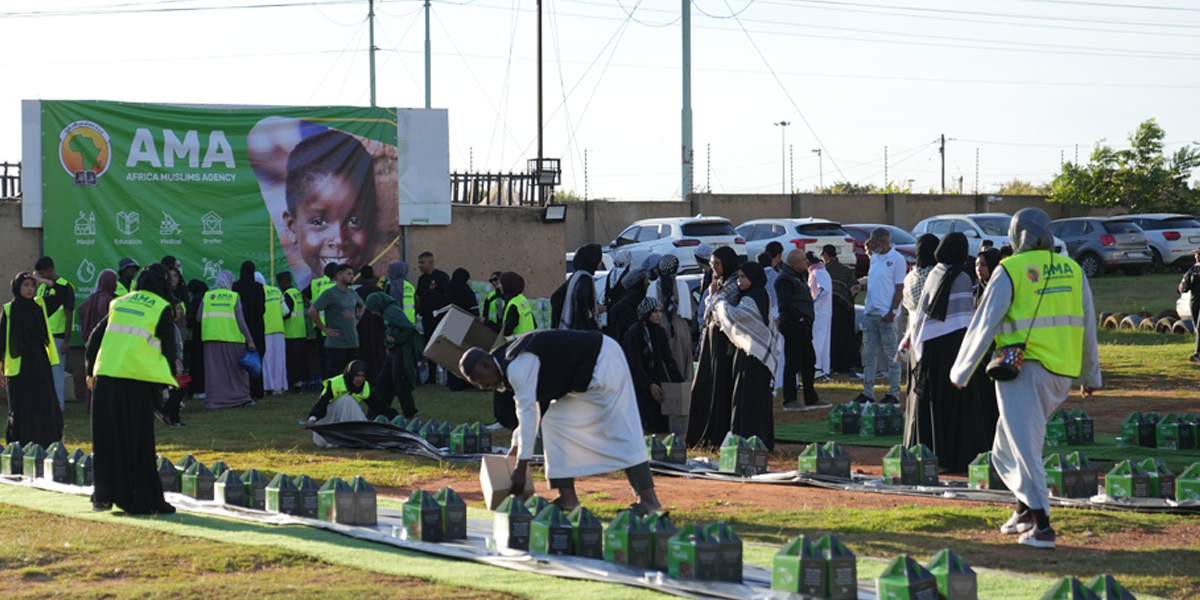
It is within this context that Africa Muslims Agency (AMA), alongside many others, has worked quietly and consistently to ease the suffering. Over the past two years, AMA has been present in Gaza, delivering essentials such as hot meals, bread, clean drinking water, infant milk, and medical assistance. Teams on the ground, often facing grave personal risks, have persevered in ensuring that aid reaches those who need it most.
“People pass the hours moving from one line to another — from a queue for food that may not fill every pot to another for a few litres of water; barefoot children who know nothing of childhood except the date printed on their birth certificates” Al-Akhras explains. “Children, women, the elderly — none have been spared. Families sit in worn-out tents trying to piece together fragments of daily life. One mother lights firewood, if she was lucky enough to receive some, to cook a meal that merely staves off hunger.
Yet even in the darkness, she finds strength in small mercies. “Nothing eases the bitterness of these circumstances like faith,” she says. “We draw hope from fleeting smiles — a child with a bottle of water, a father with a bag of flour, a mother who finally secured milk for her baby. These passing glimpses of hope keep us going.”
Their efforts are not about recognition but about humanity — a response to the urgent cries of families enduring unimaginable hardship. Reflecting on this sombre anniversary, it is clear that humanitarian aid alone cannot solve the crisis. But for the people of Gaza, each parcel of food, each tank of clean water, and each loaf of bread offers the reminder that they are not forgotten.
Two years on, the people of Gaza continue to embody faith in the face of adversity. And as the world watches, there remains a shared responsibility: to stand with them, to amplify their voices, and to ensure that compassion does not falter in the face of prolonged suffering.